A BAHD acyltransferase STBR1 confers both saline-alkali tolerance and blast resistance by stabilizing the non-canonical catalase CATA to promote H2O2 scavenging in rice
Abstract
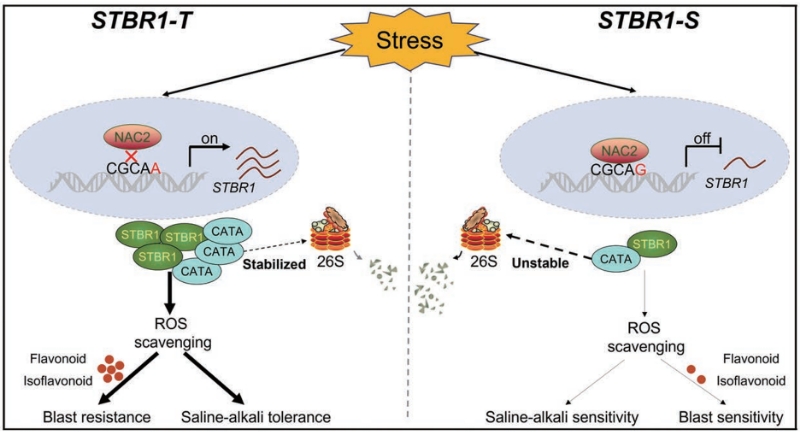
Soil salinization and blast disease are major constraints on global rice production. Although plants modu late oxidative homeostasis to withstand such stresses, the genetic components that coordinate abiotic and biotic stress responses through reactive oxygen species scavenging remain poorly defined. Here, we iden tify STBR1, a BAHD acyltransferase-encoding gene, as a key regulator that confers both saline-alkali stress tolerance and blast resistance. Through association analysis and transgenic validation, we show that STBR1 overexpression enhances stress tolerance and increases grain yield. Mechanistically, yeast two hybrid, co-immunoprecipitation, and biochemical analyses reveal that STBR1 physically interacts with and stabilizes the non-canonical catalase CATA, thereby promoting H 2 O 2 scavenging and mitigating oxida tive damage. We further identified a natural elite haplotype, STBR1-T, which harbors a promoter mutation that weakens binding by the transcriptional repressor NAC2—as confirmed by electrophoretic mobility shift assay and chromatin immunoprecipitation–qPCR—resulting in elevated STBR1 expression and enhanced stress resilience in rice. Together, our findings define the NAC2–STBR1–CATA regulatory module as a central hub that coordinates oxidative homeostasis under combined abiotic and biotic stresses. The STBR1-T allele represents a valuable genetic resource for breeding high-yielding rice cultivars with robust, broad-spectrum stress resistance.