Arabidopsis Mutants
Mutant Overview
The enzyme encoded by the GSNOR (S-nitrosoglutathione reductase) gene is a key component in regulating the homeostasis of nitric oxide (NO) in organisms. In plants, it controls the accumulation level of NO by degrading S-nitrosoglutathione (GSNO) It then participates in growth and development, stress response and cross-regulation of hormone signals.
PIN3 (At1g70940) belongs to the PIN family of auxin efflux carriers and is responsible for the "lateral polar transport" of auxin (such as gravity response at the root tip and phototropic regulation of the hypocotyl). It is highly expressed in root cap and epidermal cells of the hypocotyl. The T-DNA fragment is inserted into the coding region of PIN3 (At1g70940), resulting in the disruption of PIN3 transcription and the inability to synthesize the normal-functioning auxin transporter protein PIN3.
The pin3-5 hot5-2 mutant simultaneously carries the "auxin transport defect (pin3-5)" and the "NO metabolism defect (hot5-2)", which is used to elucidate the "auxin - NO cross-signaling pathway" and its coordinated regulation of plant growth and development.
The target gene TIR1 (At3g62980) encodes the F-box protein of the SCF^TIR1/AFB ubiquitin ligase complex, which is involved in binding to auxin and mediating the ubiquitination and degradation of AUX/IAA inhibitory proteins, thereby activating the auxin signal. The tir1-8 mutant has a reduced efficiency in activating the auxin signal.
The tir1-8 hot5-2 mutant exhibits both "reduced auxin signaling (tir1-8)" and "NO metabolism defect (hot5-2)", which is used to investigate whether NO regulates plant growth through the auxin signaling pathway.
Arabidopsis Mutant Lines Details
| Name (名称) | Target Gene Function (靶基因功能) | Mutation Type (突变类型) | Phenotype Trend (表型趋势) | Seed Count(种子数) |
|---|---|---|---|---|
| hot5-2 | GSNOR, S-nitrosoglutathione reductase (NO代谢) | T-DNA Insertion (T-DNA插入突变) | Compared with the wild type (Col-0), the main root is shorter and the number of lateral roots is significantly reduced. Under ABA treatment, root growth inhibition was more obvious. | 2000 |
| pin3-5 | PIN3 vector,auxin transporter(生长素运输) | T-DNA Insertion (T-DNA插入突变) | The root-oriented terrestrial response was significantly weakened; The length of the main root showed no significant difference from that of the wild type, but the distribution of lateral roots was more random. | 300 |
| pin3-5hot5-2 | auxin transport & NO metabolism(生长素运输及NO代谢) | Double Mutant (双突) | The phenotype is more significant than that of the single process (hot5-2 or pin3-5) : compared with the wild type, the main root is extremely short, the lateral roots are very few, and the root-to-earth orientation is basically lost. | 150 |
| tir1-8 | TIR1 vector,auxin receptor(生长素信号) | Point Mutation/Missense(点突变) | Root elongation is not sensitive to auxin (such as IAA) treatment; The number of lateral roots is approximately 60% less than that of the wild type, and the growth rate of the main root slows down. | 4000 |
| tir1-8hot5-2 | auxin signaling & NO metabolism(生长素信号及NO代谢) | Double Mutant (双突) | Synergistic inhibitory effect: Compared with the wild type, the main root is shorter than any single process, and lateral roots are rare. The sensitivity to ABA and high-salt stress was significantly enhanced. | 80 |
Phenotype Image
Phenotypic comparison of Arabidopsis mutants and wild type :
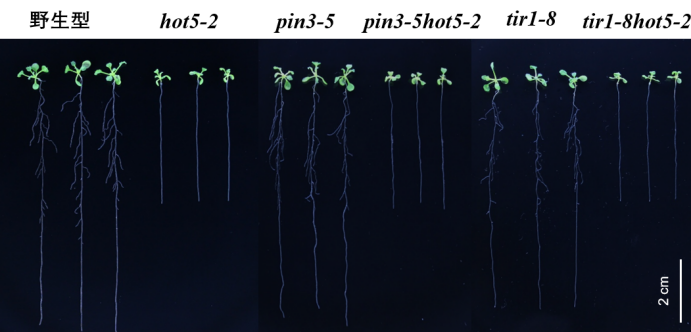
From left to right: Wild type (Col-0), hot5-2, pin3-5, pin3-5hot5-2 (double mutant), tir1-8, tir1-8hot5-2 (double mutant).