Wheat Mutants - TaGW2 Mutants
Mutant Overview
TaGW2 is a key RING-finger type ubiquitin E3 ligase gene in wheat. It mainly regulates the degradation of multiple target proteins through the ubiquitin-26S proteasome pathway and exerts multiple regulatory functions on wheat yield, quality, and stress resistance.The following collection of TaGW2 mutants includes three types of materials: near-isogenic lines (Cadenza induced by EMS and continuously backcrossed with Paragon for four generations), overexpression (OE) lines (with Fielder as the wild type), and RNA interference (RNAi) lines (with Fielder as the wild type), providing tools for loss-of-function and gain-of-function studies.
TaGW2 Near-Isogenic Mutants
Mutant lines with premature termination mutations, backcrossed to BC4F3 generation:
| Name (命名) | Mutation Type (突变类型) | Generation (代数) | Seed Count (种子数) |
|---|---|---|---|
| TaGW2-a | Premature termination (提前终止) | BC4F3 | 200 |
| TaGW2-b | Premature termination (提前终止) | BC4F3 | 200 |
| TaGW2-d | Premature termination (提前终止) | BC4F3 | 200 |
| TaGW2-abd | Premature termination (提前终止) | BC4F3 | 200 |
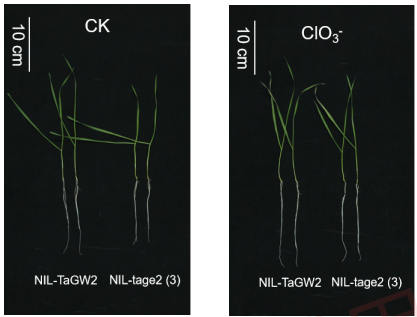
TaGW2 Near-isogenic lines (TaGW2-abd) vs Wild Type under normal growth and chlorate conditions.These mutants show no significant morphological differences from the wild type at the seedling stage under normal growth conditions, but exhibit a stress-sensitive phenotype under chlorate conditions.
TaGW2 Overexpression (OE) Lines
Overexpression lines stabilized to T3 generation:
| Name (命名) | Generation (代数) | Seed Count (种子数) |
|---|---|---|
| OE1 | T3 | 100 |
| OE2 | T3 | 100 |
| OE3 | T3 | 100 |
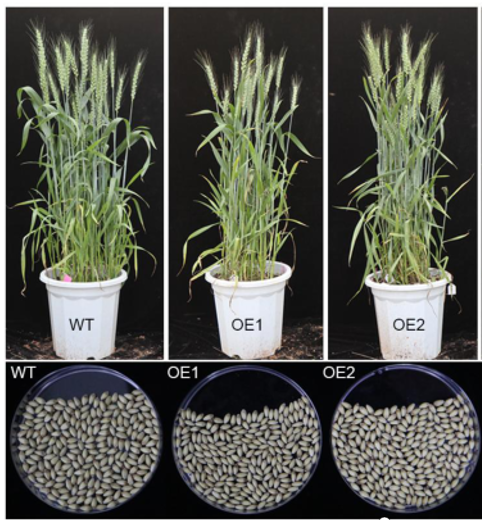
Comparison of TaGW2 Overexpression Lines (OE1/OE2) vs Wild Type (Fielder) on grains. These overexpression lines exhibit smaller grains and decreased grain weight compared to the wild type.
TaGW2 RNA Interference (RNAi) Lines
RNAi lines stabilized to T3 generation:
| Name (命名) | Generation (代数) | Seed Count (种子数) |
|---|---|---|
| RI1 | T3 | 100 |
| RI2 | T3 | 100 |
| RI3 | T3 | 100 |
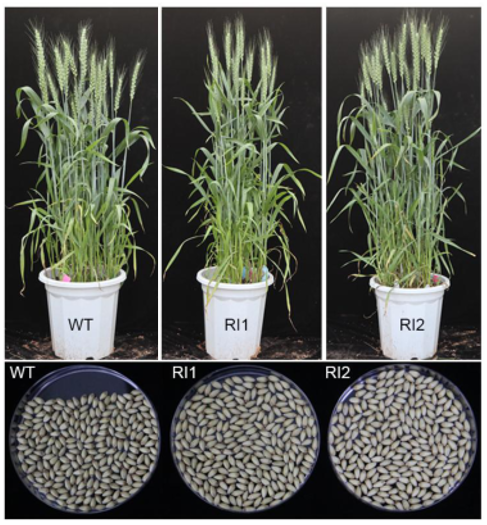
Comparison of TaGW2 RNA interference lines (RI1/RI2) vs Wild Type (Fielder) on grains. These RNAi lines exhibit larger grains and increased grain weight compared to the wild type.